Architecture
The toolbox separates the specification of an alignment objective from the heavy dynamic-programming computation. This mirrors the graph-based formulation in the paper. [1]
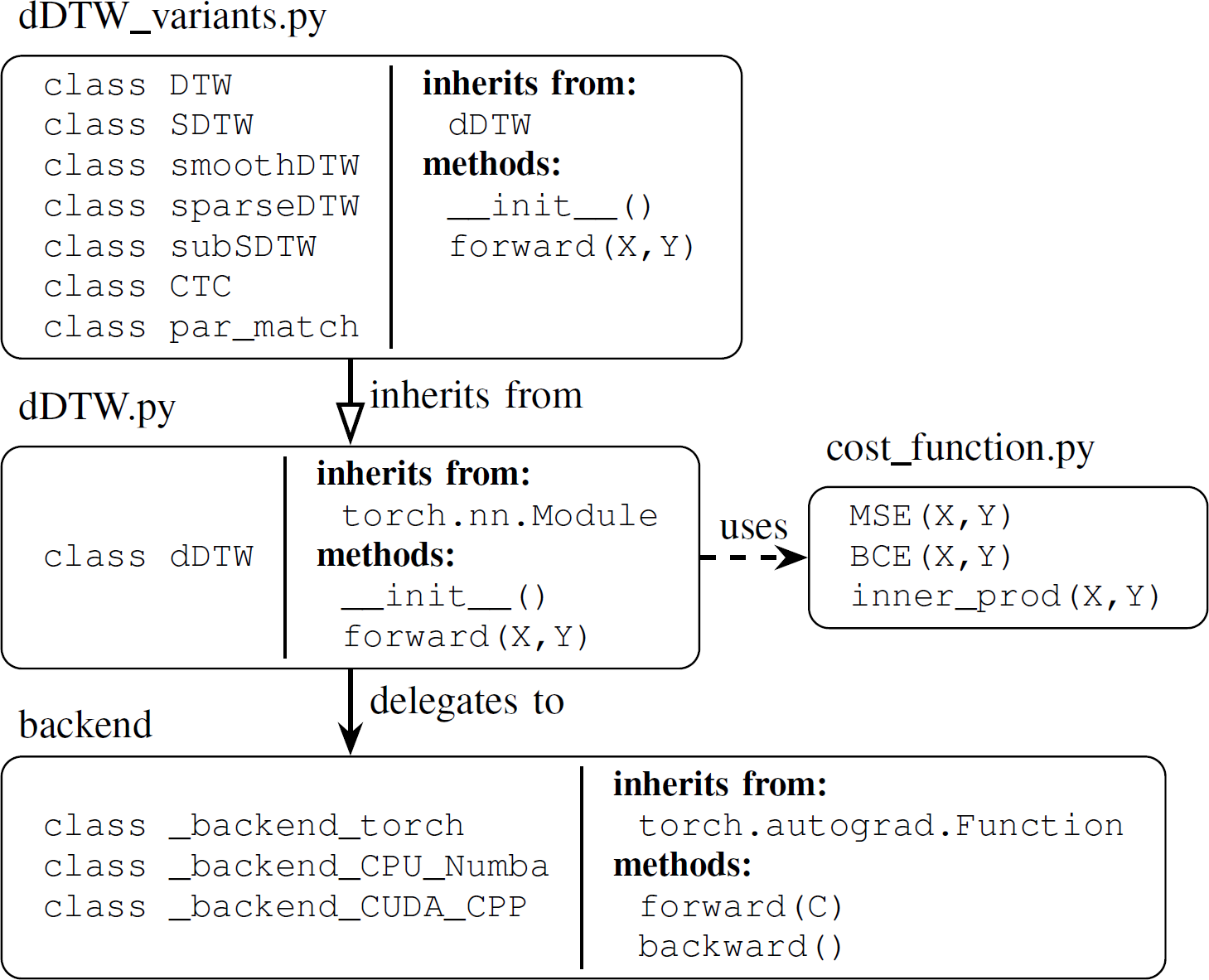
Frontend
The central frontend is ddtw.ddtw.dDTW, a torch.nn.Module.
It
defines an alignment graph through:
a local cost function,
an aggregation operator,
step sizes,
global or local step weights,
start and end boundary conditions,
optional boundary penalties,
sequence lengths and normalization.
The predefined classes in ddtw.ddtw_variants are thin frontends
that fix these parameters for standard objectives such as SDTW, CTC and
partial_matching. Users can still instantiate dDTW directly to build
new graph configurations or hybrid objectives.
Cost Matrix
When X and Y are passed to a loss, the frontend first computes the local
cost matrix C. The matrix contains all pairwise values c(x_n, y_m). The
toolbox also accepts a precomputed C directly, which is useful when a model
or task-specific routine computes the local costs.
Backend Dispatch
The alignment cost and its gradient are computed by backend classes that extend
torch.autograd.Function. They implement explicit forward and backward
dynamic-programming recursions. This backend computation is shared by the
alignment variants: changing from SDTW to CTC or partial matching changes the
graph configuration, not the core dynamic-programming implementation.
The backend argument of dDTW selects one of three concrete backend
modules, or the auto dispatcher:
auto: selectscuda_cpp, thencpu_numba, thentorch.torch: reference PyTorch implementation inbackend/backend_torch.py.cpu_numba: Numba-accelerated CPU implementation inbackend/backend_cpu_numba.py.cuda_cpp: optimized CUDA extension backend inbackend/backend_cuda_cpp.py.
Backend Module Structure
The backend files are intentionally similar:
local minimum-function definitions or dispatch constants,
forward dynamic-programming routine,
backward dynamic-programming routine,
one
torch.autograd.Functionclass,optional debug matrix storage through
store_debug.
The Torch and CPU Numba modules contain their minimum-function implementations
directly in Python/Numba. The CUDA C++ backend delegates to the compiled
extension; its minimum functions live in backend/csrc/ddtw_cuda.cu and are
selected by integer dispatch ids. The CUDA backend follows the same broad
forward/backward extension pattern used in prior PyTorch Soft-DTW CUDA
implementations. [2]
References